
As I mentioned in my last post, on February 2 the mountain yellow-legged frog was listed under the California Endangered Species Act. I'm in the process of researching how this listing will affect the management of the frog and its habitat. In the mean time, I thought I'd share a recent story published in Scientific American that serves as a grim reminder of the dire circumstances that amphibians face today. You can view the story here. Let's hope that we can avoid a similar situation with the mountain yellow-legged frog.
Back to The Mountain Yellow-legged Frog Site.
Showing posts with label Endangered Species Act. Show all posts
Showing posts with label Endangered Species Act. Show all posts
February 27, 2012
A Grim Future For Amphibians


February 6, 2012
Mountain Yellow-legged Frog is Listed Under California ESA

To start discussion of the frog agenda item, the chief of the Department of Fish and Game (DFG) Fisheries Branch, Stafford Lehr, gave a summary of the DFG mountain yellow-legged frog status review, and made the recommendation that both species be listed under the California ESA. After Mr. Lehr answered a few questions from the Commission, DFG Director Chuck Bonham made a brief statement in which he reaffirmed the DFG mission to protect California's biodiversity. Lisa Belenky from the Center for Biological Diversity (the group that originally petitioned the DFG to list both species) took the podium, commended the DFG status review for its thoroughness, and stated that although she thought both frog species should be listed as "endangered" she supported the DFG recommendations. With that, the Commission voted 5-0 to list both species. It was over in less than 30 minutes.
What made this listing decision different from most previous such decisions was the almost complete lack of controversy. Lehr, Bonham, and members of the Commission all mentioned that the unusually large amount of information associated with both species of the mountain yellow-legged frog provided a solid foundation for the DFGs threatened/endangered recommendation. I've long argued that science can (and should) play an important role in helping to resolve natural resource issues, and this listing decision strongly supported that role. Science clearly cannot provide all of the answers, but when conducted in a thorough manner it can at least provide sideboards to resource-related discussions.
In my next post, I'll discuss what this listing likely means for frogs and potentially-affected user groups (e.g., anglers).
Back to The Mountain Yellow-legged Frog Site.
January 24, 2012
State Listing Decision Nears for Mountain Yellow-legged Frog

At their February 2 meeting, the Commission will accept comments from the public regarding the listing petition or status review, and may vote on whether to list both species under the California ESA. Comments can also be sent to the Commission at the following address: Fish and Game Commission, 1416 Ninth Street, Box 944209, Sacramento, California 94244-2090 (or via e-mail to fgc@fgc.ca.gov). To be considered, comments must be received by the time of the February 2 meeting. The meeting starts at 8:30 AM in Sacramento, is open to the public, and will be broadcast live. The meeting agenda [PDF] states that the mountain yellow-legged frog item is the last item of the day, but there is no indication of at what time discussion of this item will begin.
The potential listing of both species under the U.S. Endangered Species Act also continues to move forward. As I've mentioned in previous posts, the U.S. Fish and Wildlife Service (USFWS) is leading a multi-agency effort to develop a Conservation Strategy for the mountain yellow-legged frog. At the recent California-Nevada Amphibian Populations Task Force meeting (Placerville, January 12-13), Steven Detweiler (USFWS) gave an update on the progress made to date. The group is tackling a range of challenging issues, including how best to restore mountain yellow-legged frog populations in the presence of chytridiomycosis (the disease caused by the amphibian chytrid fungus) and how to prioritize sites for restoration actions. A draft document is scheduled for release by the end of 2012.
So, you can expect the mountain yellow-legged frog to be in the news a lot during the coming weeks and months. Stay tuned.
Back to The Mountain Yellow-legged Frog Site.
September 26, 2011
Another Field Season......

In my absence from the front country, lots has happened in the world of frog conservation. Most importantly, perhaps, was the die-off of more than 100 mountain yellow-legged frogs being housed at Fresno's Chaffee zoo. The cause of death remains a mystery. These frogs were collected in southern California as part of an effort to establish another captive breeding colony, the progeny of which could eventually be released back into the wild. This incident should serve as an important reminder of how difficult it is to maintain healthy frog populations in captivity. Whenever possible, I'd like to instead see concerted efforts to establish frog populations in suitable natural habitats across the range of the frog. Populations of the mountain yellow-legged frog have tremendous reproductive potential, and under the right conditions could produce lots of offspring for reintroduction to additional sites. And those offspring would come at a fraction of the cost of those from captive rearing facilities. The fact that fewer than 200 adult mountain yellow-legged frogs exist in southern California limits the options available, but I worry that the current focus on captive breeding has distracted us from a broader approach that includes trying to establish additional wild populations.
The U.S. Fish and Wildlife Service (USFWS)-led effort to develop a Conservation Strategy for Sierra Nevada populations of the mountain yellow-legged frog continues apace. This effort is still in the information-gathering phase and I expect that a draft strategy won't be released until sometime in 2012, perhaps around the time that the USFWS begins the process of deciding whether these Sierra Nevada populations should be listed under the federal Endangered Species Act. In addition, the California Fish and Game Commission will soon be meeting to decide whether to list mountain yellow-legged frogs across their range under the California Endangered Species Act. And then, both Yosemite and Sequoia-Kings Canyon National Parks continue to work on their respective park-wide aquatic restoration plans, plans that will likely propose multi-decade efforts to remove nonnative trout from key frog habitats within these jurisictions. I expect that both parks will release draft plans in 2012.
So, 2012 looks to be a busy year. Stay tuned for updates....
Back to The Mountain Yellow-legged Frog Site.
November 8, 2010
Do We Have to Exclude People to Save Frogs?
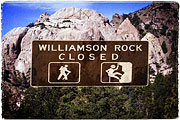
In southern California where millions of people live within a one hour drive of several national forests, human use of those public lands is intense and conflicts with sensitive species are common. In 2002 the dwindling populations of the southern mountain yellow-legged frog (Rana muscosa) in the Transverse and Peninsular Ranges were listed as "endangered" under the federal Endangered Species Act (see In the News > ESA listing page for details). In 2005 the US Fish and Wildlife Service proposed several thousand acres of stream and riparian habitat as "critical habitat" for these R. muscosa populations. In response, in late-2005 the Angeles National Forest opted to close access to 1000 acre area along Little Rock Creek due to the presence of R. muscosa in this section of creek. This resulted in the closure of a popular climbing area, Williamson Rock, because it directly abuts Little Rock Creek. The closure also prevented access to a portion of the Pacific Crest Trail, forcing hikers to use a detour that required walking along a highway for some distance.
The Angeles National Forest recently released a draft Environmental Assessment of the closure that proposes to keep the area closed for at least three more years while the response of the Little Rock Creek frog population to the 2009 Station fire is monitored.This potentially open-ended closure of the area has upset several user groups, in particular the climbing community (e.g., Friends of Williamson Rock). It is clear that user-created trails that access Williamson Rock and the proximity of some climbing routes to Little Rock Creek (some climbing routes actually start in the creek itself) have the potential to impact the frog population. However, many of these impacts would be relatively easy to mitigate. For example, the numerous user-created trails could be replaced by a single maintained trail and those climbing routes closest to the creek could be closed. In addition, climbers could be required to use "wag bags" for the disposal of all human waste. Discussions I recently had with a representative from the climbing community indicated that they are willing to work with the Angeles National Forest to implement these actions. It remains a big question whether the Forest will go along with this, however.
The easiest action for agencies to take when confronted with conflicts between human visitation and an endangered species is to simply restrict access. Although complete closures may sometimes be necessary, it is often possible to find creative solutions to conflicts that minimize impacts to sensitive species and in doing so help to build a constituency for conservation of the species. The Williamson Rock issue seems to have all the hallmarks of a situation where a suitable compromise is attainable. I hope the Angeles National Forest and Friends of Williamson Rock don't let this opportunity slip away.
Back to The Mountain Yellow-legged Frog Site.
October 11, 2010
Back from a Summer in the Mountains
It has been months since I've added any posts. My only excuse is that I've been in the mountains almost continuously since mid-June conducting research. I've been impressed at the number of people who emailed me during my absence from the blogosphere to make sure I hadn't abandoned my practice of regular posts related to the mountain yellow-legged frog. Rest assured that I have not. Now that my field season is over I'll do my best to again provide updates on a more regular basis.
Of the many frog-related happenings that occurred this summer, perhaps the most important was a decision on September 15 by the California Fish and Game Commission to designate the mountain yellow-legged frog (both Rana sierrae and Rana muscosa) as a "candidate" species under the California Endangered Species Act (CESA). This action was taken in response to a petition submitted earlier this year by the Center for Biological Diversity. The California Department of Fish and Game now has one year to develop a formal status review that will recommend whether or not the mountain yellow-legged frog should be listed.
During the one-year review period, the CESA requires that candidate species be treated as if they were already listed. This is an important difference between the Federal and California Endangered Species Acts. Under the Federal ESA, a candidate species has no formal status until it is actually listed. Because of the potential for the new "candidate" status of the mountain yellow-legged frog to immediately impact a wide variety of ongoing activities the Commission adopted a series of "take" exemptions (i.e., exemptions for actions that could potentially result in harassment or mortality of mountain yellow-legged frogs).
Exempted actions include those for the Department's ongoing fish stocking programs (no surprise there), timber harvest, reservoir operations, and scientific research. Although some have expressed their displeasure with these exemptions, I support them because they will provide individuals and agencies with some breathing room to continue already-permitted activities during the one-year review period. The negatively publicity that could result from an immediate shutting down of these existing projects (especially fish stocking) would likely have more long-lasting negative effects on frog conservation efforts than these projects would.
So, by next October we'll get an up-or-down vote by the Commission on the listing status of the mountain yellow-legged frog. If the frog is listed under CESA I suspect that efforts to conserve and restore populations of this imperiled species will ramp up to a level not yet seen.
Back to The Mountain Yellow-legged Frog Site.
March 8, 2010
A Busy Week in the Media for California Amphibians and Fish
 The media was abuzz this week with frog and fish-related stories. First came the news that the California Fish and Game Commission voted 3-2 to support the listing of the California tiger salamander as "threatened" under the California Endangered Species Act (Santa Rosa Press-Democrat story). Because this species is already federally-listed I don't think this will change the existing management significantly.
And then last Tuesday there was an excellent discussion about nonnative fish impacts on NPRs Diane Rehm show (archive available here). This show topic was prompted by the publication of the book, "An Entirely Synthetic Fish: How Rainbow Trout Beguiled America and Overran the World", by Anders Halverson. This is a must-read book that provides an exploration of the history, biology, and sociology of trout aquaculture and stocking. Anders was joined on the show by Curtis Milliron from the California Department of Fish and Game and Gerald Smith from the University of Michigan, and the three of them contributed to a lively discussion.
And finally, we had the publication of a new study by Tyrone Hayes (UC Berkeley), this one showing that exposure of frogs to low doses of the herbicide atrazine can result in complete feminization of males. The authors state, "Ten percent of the exposed genetic males developed into functional females that copulated with unexposed males and produced viable eggs." These results are remarkable and scary. If atrazine causes these bizarre effects in frogs, what effects does this stuff have on humans?
Back to The Mountain Yellow-legged Frog Site.
March 1, 2010
Lawsuit Update and Other Legal Intrigue
 In my last post I mentioned that in addition to the fish stocking lawsuits recently filed by the Center for Biological Diversity and the Owens Valley Committee I'd heard rumor of a third lawsuit. That rumor has now been substantiated. It was filed by Californians for Alternatives to Toxics, the Environmental Protection Information Center, Wilderness Watch, and Public Employees for Environmental Responsibility. Their petition focuses on many of the same issues covered by the other two petitions, including use of an improper objective, improper baseline against which impacts were evaluated, inadequate range of alternatives, and failure to adequately mitigate impacts of fish stocking. In addition, the petitioners argue that the practice of stocking fish into designated wilderness areas violates provisions of numerous laws related to wilderness.
On a somewhat different topic, on March 3 the California Fish and Game Commission is scheduled to vote on a petition to list the California Tiger Salamander as "threatened" under the state Endangered Species Act. This will be an interesting vote given its potential to put into place additional protections for this species, and also for what it will tell us about the likelihood that the Commission will vote to list the mountain yellow-legged frog under the California Endangered Species Act. The effort to list the California Tiger Salamander under the state Endangered Species Act is quite a twisted tale, with the Commission rejecting the original 2001 petition, rejecting a subsequent 2004 petition, this decision being overturned by the Sacramento Superior Court, the Commission appealing the court's decision, and the 2008 decision by the Third District of the California Court of Appeals upholding the original Superior Court decision. Now, almost 10 years after the original petition was filed, the Department of Fish and Game is recommending to the Commission that the species be listed as "threatened". For more information on this issue, click here.
The information upon which the latest petition is based is essentially unchanged over the decade since the original petition was filed, so why all of the legal contortions to prevent the listing? Delaying the inevitable seems to be the name of the game. It doesn't make for good policy, but it does make for good politics for those whose sympathies lie more with unbridled economic development than with the fate of this inconspicuous salamander that spends its life in and around vernal pools in California's grasslands.
Back to The Mountain Yellow-legged Frog Site.
February 1, 2010
California Endangered Species Act Petition is Filed
 On January 11, 2010, the California Department of Fish and Game (DFG) released their badly flawed fish stocking EIR-EIS. In response to the failure of the EIR-EIS to put into place provisions to adequately protect the imperiled mountain yellow-legged frog from impacts caused by hatchery trout, on January 25 the Center for Biological Diversity petitioned the California Fish and Game Commission ("Commission") to list the mountain yellow-legged frog as "endangered" under the California Endangered Species Act (CESA).
The CESA is similar to the federal Endangered Species Act in most regards but the CESA is administered by the DFG. The DFG now has 90 days to recommend to the Commission whether the petitioned action may be warranted. If so, the DFG has 12 months to prepare a report for the Commission, based on the best scientific information available, which indicates whether the petitioned action is in fact warranted. The Commission then makes it final decision soon thereafter. So, it will be more than a year before the petition makes its way through the process, a process that I suspect will be full of twists and turns. This could get interesting.
Additional details on the petition process are provided in Fish and Game Code Section 2070-2090. The mountain yellow-legged frog CESA petition is available on the Center for Biological Diversity web site.
Back to The Mountain Yellow-legged Frog Site.
June 6, 2008
The Increasing Inadequacy of the Endangered Species Act
 The Endangered Species Act (ESA) was signed into law in 1973, and is responsible for bringing numerous species back from the brink of extinction. However, 35 years after its signing the ESA is increasingly showing its age. In 1973, most species endangerment was the result of local impacts that were relatively easy to identify and the resolution of which was generally straightforward. For example, Brown Pelicans were driven into decline by increased DDT concentrations in the environment. DDT was banned in the U.S. in 1972, and Brown Pelican populations have rebounded dramatically.
Although the current declines of many species have similarly identifiable causes, an increasing number have complex causes that are challenging the relevance of the ESA. The polar bear and the mountain yellow-legged frog provide two examples of the problems posed by this complexity. The polar bear was recently listed as "threatened" under the ESA due to current and projected declines resulting from global warming. Unfortunately, the ESA was designed to deal with local threats such as habitat destruction, not global threats like climate change, and therefore lacks the tools necessary to deal with challenges as complex and far-reaching as global warming. Even if the ESA contained tools that would aid in reducing carbon dioxide emissions in the U.S., the ESA of course lacks the ability to regulate emissions in other countries.
The mountain yellow-legged frog (Rana muscosa, Rana sierrae) that inhabits the mountains of California presents a related but different challenge for the ESA. These two species have declined by more than 90% during the past century. Once the most common vertebrate across much of their range, they are now one of the rarest. R. muscosa in southern California was listed as "endangered" in 2002 and the listing of R. muscosa and R. sierrae in the Sierra Nevada was found to be "warranted" in 2003. The primary threat to these species through the 1970s was likely the introduction of nonnative trout into historically fishless lakes and streams. That threat is now been compounded by the emergence of the disease, chytridiomycosis, that is decimating mountain yellow-legged frog populations once thought to be secure because of the local absence of introduced fish.
If introduced fish were the only threat to mountain yellow-legged frogs, a recovery plan presumably would identify water bodies from which fish should be removed, and those removals would allow frog populations to rebound. Simple, right? Given the known importance of disease in driving current declines, what tools does the ESA give us to deal with this threat? Very few, if any. The biggest challenge caused by chytridiomycosis is that we don't even know what caused the emergence of this disease. Was it human-caused (e.g., climate change) or was it caused by the natural evolution of a more virulent strain? Disentangling "natural" from human-caused stressors is already extremely challenging, and will become much more so in coming decades as subtle effects of climate change, contaminants, and ecosystem changes become ever-more pervasive.
In the case of chytridiomycosis, even if disease emergence was human-caused, we currently have no means of eradicating the disease. Therefore, many species being pushed toward extinction by chytridiomycosis are doomed, and yet the ESA provides no mechanism for triage. Alternatively, if chytridiomycosis is the result of a natural evolutionary event (which will be very difficult to show conclusively), should we try to counteract the effect of that natural event? If yes, how should we allocate scarce resources between species being driven to extinction by anthropogenic causes versus apparently natural causes?
Our inability to distinguish between natural and human-caused species declines and questions on how to respond to these types of declines will increasingly compromise our ability to halt the impending flood of species extinctions. In our ever more complex world, our only hope of slowing the rate of human-caused extinctions may be an international "Endangered Ecosystems Act". More about that pipe dream some other time.
Back to The Mountain Yellow-legged Frog Site.
Subscribe to:
Posts (Atom)


